The Politics of Moderation in Modern European History by Unknown
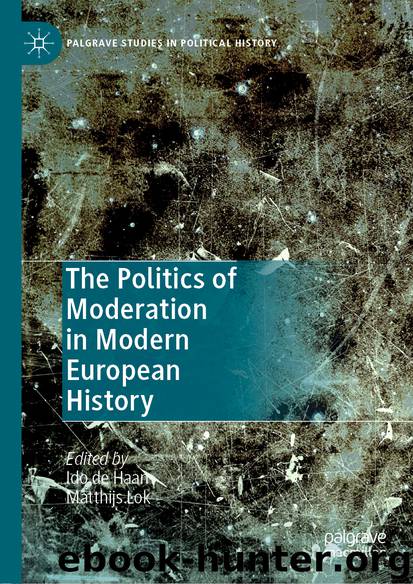
Author:Unknown
Language: eng
Format: epub
ISBN: 9783030274153
Publisher: Springer International Publishing
Social Liberalism and Democratic Socialism
It is in the context of these wide-ranging challenges that the German historians Alexander Gallus and Eckhard Jesse date the first emergence of an ideology of the third way in the work of the progressive liberals and Kathedersozialisten of the Verein für Sozialpolitik like Adolph Wagner, Lujo Brentano and Gustav Schmoller. These intellectual representatives of a revised liberalism tried to steer a ‘middle course between anarchic individualism, traditionalist corporatism and bureaucratic statism’—as Thomas Nipperdey characterized their position. 5 This was clearly not only a German debate. Around 1900, the sentiment of crisis was widespread among the European liberal bourgeoisie. 6 In all parts of Europe, liberals tried to forge a way out by looking for mediation between ideological extremes. In the United Kingdom, such a road was taken by Leonard T. Hobhouse, who argued that in confrontation with the disruptive tendencies of laisser faire , liberal individualism ‘is driven no small distance along Socialist lines. Once again we have found that to maintain individual freedom and equality we have to extend the sphere of social control’. 7 In the Netherlands, the liberal discovery of the social question led to a cross-class cooperation of social reformers, who agreed on the idea that the respectability of the working classes required social policies to protect them from the vagaries of the market economy. It formed the foundation for the installation in 1897 of a ‘government coalition of social justice’, led by the progressive liberals Nicolaas G. Pierson and Hendrik Goeman Borgesius, who introduced a series of social laws with regard to social insurance against labour accidents, housing, education, and child protection. 8
Yet the search for a middle became particularly acute in Germany. The Gründerkrise that had accompanied the founding of the Reich and the simultaneous second Industrial Revolution posed a direct challenge to the German liberals, and urged them to present a coherent ideological alternative to the apparently irresistible democratic demands of the lower classes, to infractions of the rule of law by the imperial regime, and to the ideological challenges to liberalism formulated by socialism, social Catholicism, and nationalism. 9 On the one hand, they had to formulate a position with regard to the transformation of German politics as a result of the introduction of general male suffrage, the rise of mass parties and the participation of broad sections of the population. On the other hand, they had to formulate a convincing answer to the crisis-ridden social relation in the era of an unbridled capitalism. Both tendencies, of rampant capitalism and irresistible democratization, were closely related, and also required a combined answer, in the form of a ‘compensation for the social inequalities caused by capitalism’. 10
German liberals at the end of the nineteenth century rejected the authoritarian and militarist tendencies of the Wilhelmine Empire, exemplified by Bismarck’s anti-democratic statement that ‘it is not by speeches and majority resolutions that the great questions of the time are decided—that was the big mistake of 1848 and 1849—but by iron and blood’.
Download
This site does not store any files on its server. We only index and link to content provided by other sites. Please contact the content providers to delete copyright contents if any and email us, we'll remove relevant links or contents immediately.
International Integration of the Brazilian Economy by Elias C. Grivoyannis(111317)
The Radium Girls by Kate Moore(12093)
Turbulence by E. J. Noyes(8113)
Nudge - Improving Decisions about Health, Wealth, and Happiness by Thaler Sunstein(7758)
The Black Swan by Nassim Nicholas Taleb(7195)
Rich Dad Poor Dad by Robert T. Kiyosaki(6727)
Pioneering Portfolio Management by David F. Swensen(6341)
Man-made Catastrophes and Risk Information Concealment by Dmitry Chernov & Didier Sornette(6139)
Zero to One by Peter Thiel(5864)
Secrecy World by Jake Bernstein(4798)
Millionaire: The Philanderer, Gambler, and Duelist Who Invented Modern Finance by Janet Gleeson(4538)
The Age of Surveillance Capitalism by Shoshana Zuboff(4352)
Skin in the Game by Nassim Nicholas Taleb(4306)
The Money Culture by Michael Lewis(4267)
Bullshit Jobs by David Graeber(4250)
Skin in the Game: Hidden Asymmetries in Daily Life by Nassim Nicholas Taleb(4051)
The Dhandho Investor by Mohnish Pabrai(3825)
The Wisdom of Finance by Mihir Desai(3788)
Blockchain Basics by Daniel Drescher(3633)
